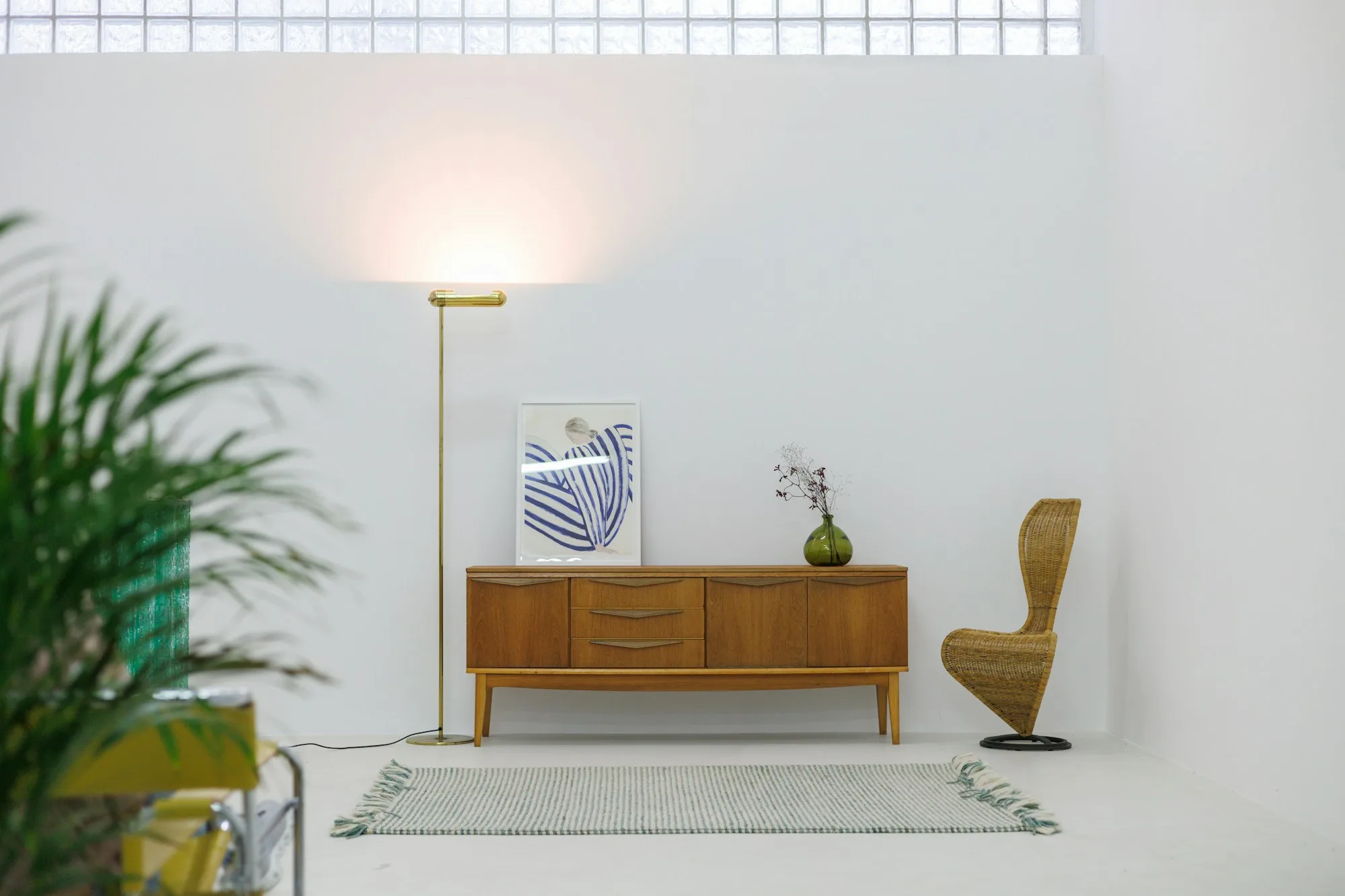
The first thing I do with any chair is turn it upside down. It takes ten seconds, and it tells me more than an hour of admiring the thing from across the room, because the underside is where honest furniture keeps its paperwork. After years of buying mid-century pieces for the shop, I can tell you that most fakes fail in the first minute, if you know where to look.
This guide covers the checks I actually use: where makers hid their labels, how to date G Plan, Ercol and Parker Knoll by label colour alone, the two Scottish makers that deserve far more attention than they get, what the Danish Control mark means, and the joinery and wood tells that no reproduction gets quite right. "Mid-century" is a loose term, covering roughly the late 1940s to the early 1970s, but the identification habits below hold across all of it.
Start underneath: where the labels live
Makers of this era were proud, and they signed their work. Just never anywhere you'd see it in a sitting room. Chairs are marked under the seat, usually towards the back rail. Sideboards and chests hide their labels inside a drawer, on the back panel, or stamped into the drawer base. Tables are marked under the top or inside the frame.
So: turn chairs over, pull the top drawer right out, and get behind the piece if you can. Bring your phone torch. You're looking for paper labels, foil stickers, ink stamps and embossed marks. While you're down there you'll also see the joinery, which we'll come to. A piece that has been stripped and refinished may have lost its label in the process, which is why the label is only ever half the story.
British marks decoded: G Plan, Ercol, Parker Knoll
G Plan is the one I'm asked about most. The brand was launched in 1952 by E. Gomme of High Wycombe, and the labels changed with the decades, which makes dating straightforward:
1952 to the early 1960s: a gold embossed stamp reading "E. Gomme, High Wycombe".
Later 1960s: a red label. Here's the catch: it was a stick-on, and stick-ons can be moved. A red label alone is not proof; it needs to agree with the design, the timber and the construction.
Mid-1970s onwards: red and gold with metallic lettering, your signal that a piece is later than the classic teak era.
Ercol is even kinder to buyers. Blue labels run from roughly 1954 to 1976; gold labels from 1977 to 1995. Blue label equals the good stuff, broadly speaking. Ercol's Windsor pieces of the period used only two timbers: elm for the solid seats and table tops, with a lovely swirling grain, and beech (lighter, with a distinctive fleck) for legs and frames. My favourite Ercol tell needs no label at all. Look at the top of a chair seat where the legs come through: genuine Ercol used a wedged through-joint, and you'll see the legs' end grain as little contrasting circles in the seat itself. A copy almost never bothers.
Parker Knoll stamped a label and a model number under the seat, and the numbers are a dating tool in themselves. The Burleigh armchair, for instance, is PK716 and first appeared in 1952. As a rule of thumb, Parker Knoll pieces in teak or rosewood are usually 1960s.
The Scottish makers: McIntosh of Kirkcaldy and Beithcraft of Ayrshire
This is the section nobody south of the border writes, and it's where Scottish buyers have a genuine home advantage. These pieces turn up here more often, and often at better prices than the equivalent G Plan.
A. H. McIntosh of Kirkcaldy, founded in 1869, made some of the finest British furniture of the entire period. Look for the thistle-and-crown label. Tom Robertson was head designer from 1948 to 1983, and his teak Dunvegan sideboard of the 1960s, with its sculpted, recessed handles, now sells internationally for serious money. One thing to know: McIntosh built with quality veneers over solid ply. People sometimes see "veneer" and panic. Don't. Veneer over ply was standard practice at the quality end of the market, chosen because it's stable and shows the best grain. It is not a red flag, on McIntosh or anyone else.
Beithcraft of Beith, Ayrshire, is the sleeper. Beith was Scotland's furniture town from the mid-1800s right up to the 1980s, and Beithcraft was its biggest name. From the early 1960s their modern ranges were designed by Frank Guille, who had trained under Robin Day. The pieces have real design pedigree and still cost less than their English rivals. The firm was wound up in 1983, so anything marked Beithcraft is comfortably vintage now.
Danish pieces: the Control mark and the Wishbone test
Danish furniture attracts the most fakes, so Denmark helpfully invented a certification for it. The Danish Furnituremakers' Control was established in 1959, and its round mark, applied as a paper label, an ink stamp or a brand, guaranteed a piece had met the scheme's quality standards. Finding it is a very good sign. Genuine Danish exports also commonly carry "Made in Denmark" marks and a maker's or designer's stamp.
The most-faked chair of the lot is Hans J. Wegner's Wishbone, the CH24, designed in 1949 and made continuously by Carl Hansen & Søn since 1950. Tip it over and look under the seat towards the back. Early chairs were branded into the wood; later ones carry a sticker; current production has a label with Wegner's signature and a serial number. A "Wishbone" with a bare underside and a suspiciously friendly price is telling you what it is.
Read the joinery
While the piece is upside down, look at how it's held together. Period cabinetmaking means dovetailed drawers, dowelled joints and clean, tight work. Machine-cut dovetails are fine and normal for factory furniture of this era. What you don't want to see: staples doing structural work, glue squeezed out along the joints, or rows of bright, unmarked cross-head screws that have clearly never been touched.
One caution, because this gets repeated wrongly all over the internet: Phillips screws existed from the 1930s, so a cross-head screw does not automatically condemn a piece. Sixty-year-old screws should simply look sixty years old, dulled, with a little honest wear in the slots. It's brightness and uniformity that should bother you, not the screw head itself.
Know your woods
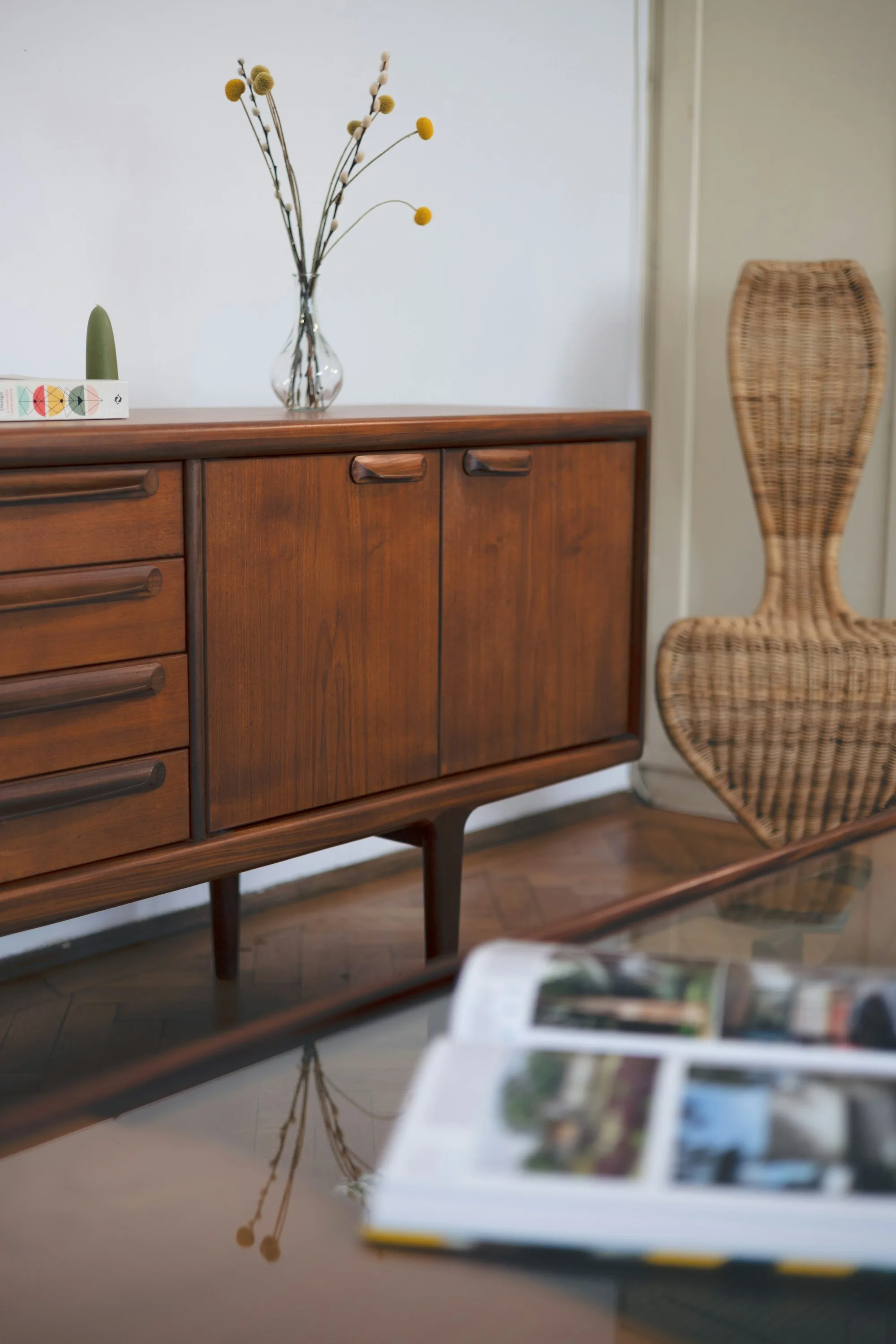
Teak is the signature timber of the era, and on cabinets it is almost always a veneer. As with McIntosh above, that's a mark of normal quality practice, not corner-cutting. Where makers spent solid timber was on the parts that take wear: legs, trims and handles. Here British makers, G Plan and Nathan among them, loved afrormosia, the so-called "African teak" (botanically no relation), used solid and slightly darker than the teak around it as a deliberate contrast. That two-tone look is a hallmark of a genuine 1960s piece; flat, uniform colour all over suggests a modern copy in stained rubberwood.
Rosewood was the luxury option of the 1960s, and it comes with one modern footnote: all Dalbergia rosewood has been CITES-listed since January 2017. Buying, owning and selling within the UK is completely unaffected. It only matters if you ever ship a piece internationally, when paperwork applies.
Repro red flags at a glance
A red G Plan label on a piece whose design and timber don't agree with it. The label was a transferable sticker.
No maker's mark, no stamp, no screw holes where a label once was, and a "designer" price tag anyway.
Staples, visible glue overflow, or bright, undisturbed screws throughout.
Flat-pack construction details: cam locks, hex bolts, chipboard edges.
Uniform colour with no solid/veneer contrast on legs, edges and handles.
Perfectly crisp edges everywhere. Sixty years of use leaves softened corners and a few honest marks.
A "Wishbone" with nothing at all under the seat.
When a missing label doesn't matter
Labels fall off. Ercol's blue labels in particular are famous for flaking away, paper labels tear, and a sympathetic refinish decades ago will have taken the sticker with it. I buy unlabelled pieces regularly and confidently, because the timber combination, the joinery, the hardware and the design all still add up. A missing label on a piece where everything else is right costs it a little resale value, nothing more. A perfect label on a piece where the construction is wrong is far more suspicious than no label at all.
Come and turn our chairs upside down
The honest truth is that this skill is learned with your hands. Photographs flatten the very things that make attribution obvious in person: weight, grain, tool marks, patina. There is a French word dealers use for the real thing found among the lookalikes, une trouvaille, and trouvailles are recognised by touch far more often than by eye. If you're in Glasgow, come and see our mid-century pieces at the shop on St Andrews Street. There's usually McIntosh in among the dining chairs and armchairs, sideboards and tables, and vintage mirrors and lighting to match. Turn things over, pull the drawers out. I'd rather you checked. And if you're hunting a particular maker or piece, get in touch and we'll keep an eye out on buying trips.