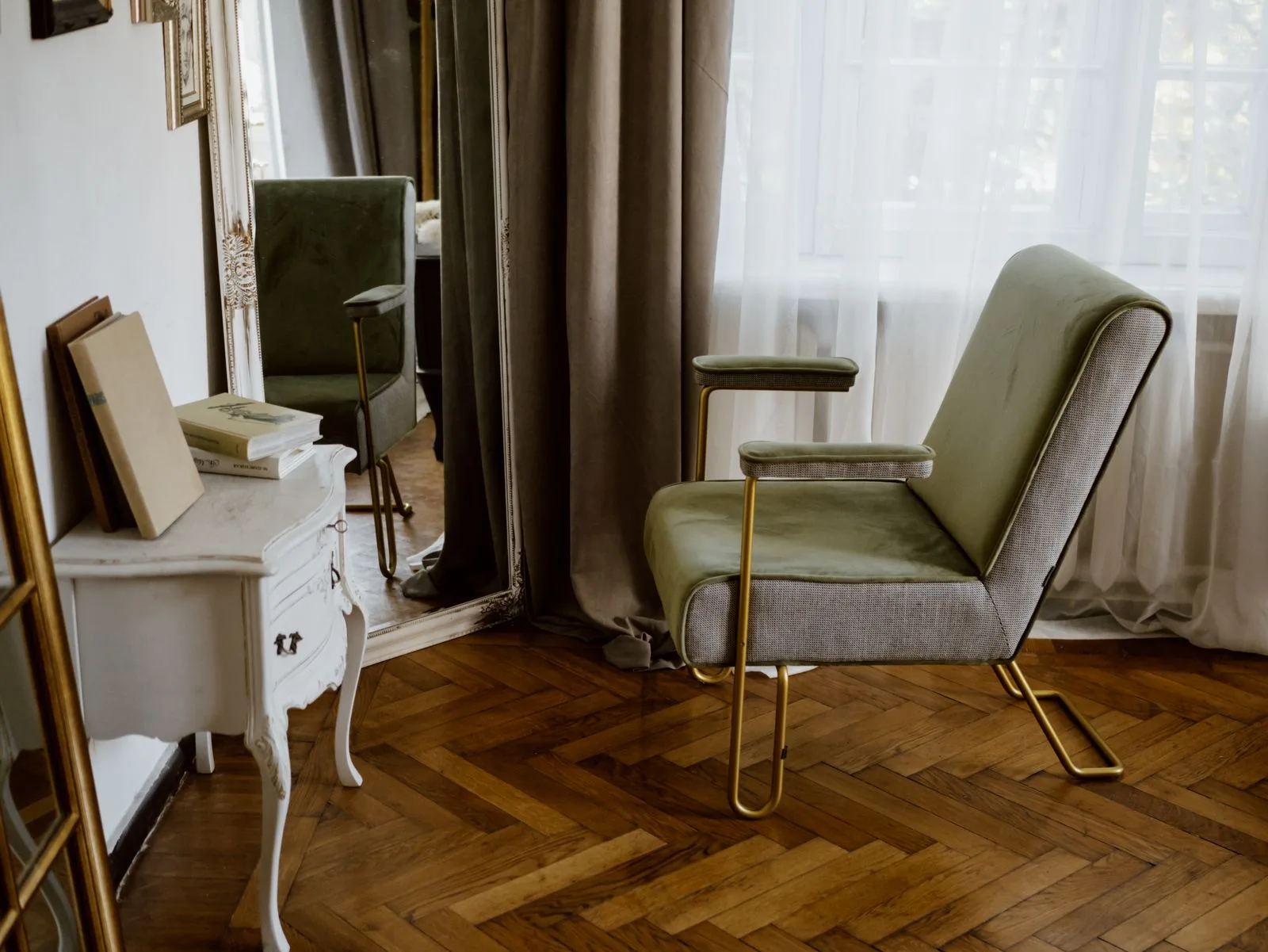
A room where everything matches tells you exactly one thing: when it was bought. A room that mixes eras (a foxed old mirror above a clean-lined console, a Victorian chair beside a contemporary lamp) tells you something far more interesting. It says a person lives there, with a history and an eye of her own. Matched rooms photograph like showrooms. Mixed rooms feel like a life.
The good news is that mixing old and new is not a talent you're born with. It's a set of habits. These are the rules I use in clients' homes and on our own shop floor here in Glasgow, and they work whether you're starting with a blank flat or a house already full of things you love.
Rule 1: Something old in every room
Every room gets at least one piece that has genuinely lived: original finish, honest wear, the surface only age can produce. I'm in good company on this one. The American designer Nate Berkus has said he's never designed a room that was all new, and makes a point of keeping "something old with its original character and patination" in every space he works on. He's right. Patina does a job that nothing from a factory this year can do. It gives a room depth, and it quietly makes the new things around it look sharper and more deliberate.
It doesn't need to be grand. A worn brass candlestick on a modern shelf will do it. But once you start looking at rooms this way, an all-new space feels strangely thin, like a film set waiting for the actors.
Rule 2: Pick your ratio
A rule of thumb designers use is 80/20. Let one era set the tone for roughly 80 per cent of the room, and let the other 20 per cent be the counterpoint. Mostly contemporary with a few serious vintage pieces, or mostly vintage with crisp modern moments. Both work beautifully.
What rarely works is 50/50. When half the room is old and half is new, the two halves compete and the eye doesn't know which story it's being told. The minority pieces are the ones people notice, precisely because they're outnumbered. If you've bought a wonderful old thing and it isn't singing, the problem is usually not the piece. It's that it has too many rivals.
Rule 3: Anchor with one serious piece
Every mixed room needs a leader. One substantial piece with real presence that everything else defers to: a sideboard, a mirror too big to ignore, a properly good armchair. The French call this kind of purchase a coup de cœur, the piece you buy because your chest tightens a little when you see it. Choose it first, place it where the eye lands when you walk in, and let it set the register for the room.
Once the anchor is in place, decisions get easier, because every new purchase only has to answer one question: does this get along with the anchor? That's the whole trick. Rooms drift into chaos when everything is an accent; they settle when one piece is clearly in charge. If you're hunting for yours, an anchor is exactly the kind of thing worth buying once and well. It's what I'm looking for on every buying trip for the collection.
Rule 4: Repeat a material three times
Contrast is what makes a mixed room exciting; repetition is what stops it feeling random. A rule of thumb I lean on constantly: pick one material or finish and make sure it appears at least three times around the room. For example:
Brass in a lamp base, again in a mirror frame, again in cabinet handles.
Aged oak in a chair, a picture frame, a bowl.
One glaze colour in a vase, a lamp, a small dish on the shelf.
Those echoes are how a 1900s piece and a 2020s piece end up looking like colleagues rather than strangers at a bus stop. The eye picks up the repeated note, often without the viewer consciously noticing, and reads the whole room as intentional. Three is the minimum for the trick to register. Twice can still look like coincidence.
Rule 5: Give it room to breathe
The most useful thing I do in a client's home is usually subtraction. Negative space is the editor. Old pieces in particular need air around them: a carved frame or a heavily grained sideboard is already visually busy, and crowding it with clutter buries exactly the detail you paid for.
If a room feels wrong, resist the urge to buy the fix. Take three things out instead and look again. Nine times out of ten the problem wasn't a missing piece; it was that the good pieces had no silence around them. A mixed room, more than any other kind, needs those pauses. They're what let the conversation between old and new actually be heard.
Rule 6: Start small: lighting, mirrors, frames
If mixing feels risky, don't start with a sofa. Start with the smaller, swappable categories: lighting, mirrors, picture frames, and the little objets that live on shelves and mantels. Berkus gives the same advice. Vintage lighting and mirrors with faded gilding are his go-to additions, because they add character and age to a room without committing it to any one look.
These pieces earn their keep twice over. They're low-stakes (if a lamp doesn't work in the sitting room, it will almost certainly work in the bedroom) and they move with you through every future rearrangement. A single old mirror can carry an entire wall of an otherwise contemporary room, which is more than most sofas can claim.
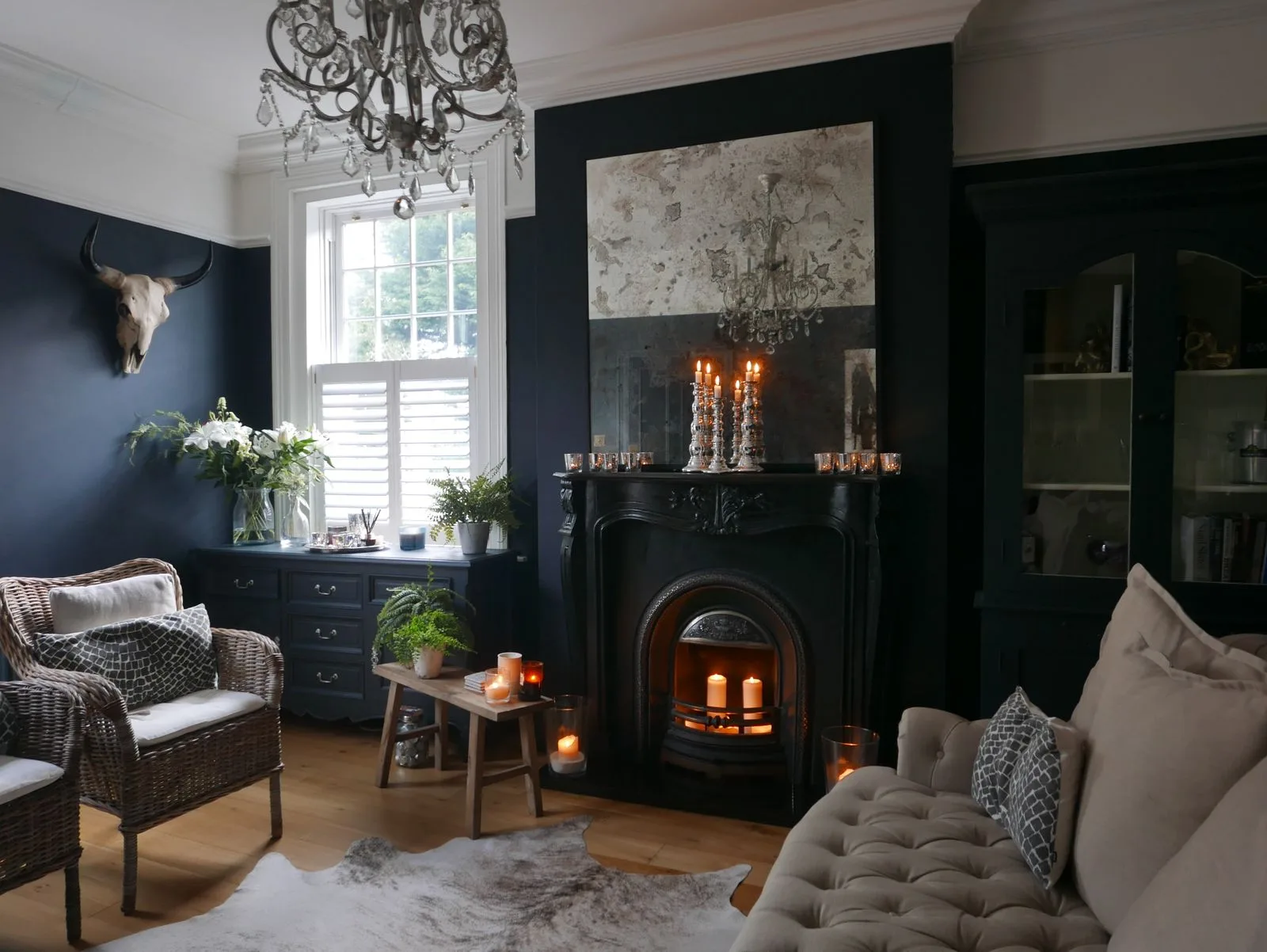
Putting it together: three pairings from the shop floor
Here's how these rules look in practice, using the kinds of pieces that pass through the shop.
A French antique chair with a contemporary ceramic lamp. The chair is the anchor and the "something old"; the lamp beside it is the 20 per cent of new. The pairing works because each makes the other clearer. The lamp's plain glaze shows off the chair's carving, and the chair's age stops the lamp looking bland.
A mid-century teak sideboard with modern glassware. Teak's strong grain wants calm company. A row of clean-lined contemporary glass on top repeats the "one material, three times" idea, glass echoed in a vase, a carafe, a candle holder, while leaving plenty of empty surface so the timber can breathe.
A vintage gilt mirror above a minimalist console. The classic starter pairing from Rule 6. The console all but disappears; the mirror does the talking; a single piece of decor, a bowl, a small sculpture, one stem in a vase, finishes it without crowding it.
The rules, en bref
Something old in every room. No exceptions.
80/20, never 50/50.
One anchor piece in charge.
One material, three echoes.
Subtract before you add.
Start with lighting, mirrors and frames.
Come and argue with me about it
Rules are for guidance, and the pleasure of this job is watching people break them well. If you're in Glasgow, come by the shop at 20 St Andrews Street. Everything on the floor is arranged by exactly the principles above, so you can see the mixing done in three dimensions before you try it at home. You can read more about the shop, or get in touch if you're hunting for a particular anchor piece and want us to keep an eye out.
Something old in every room. You'll never go back.
Bisous Bisous is an interior designer-led vintage furniture and homeware boutique in Glasgow.